Quick Links
 Quick Links
Work on those Abs!
Disclaimer: I’m not sure if my partners will agree with me on this one, but they let me write what I like. Just don’t assume they agree.
In the late nineteen eighties, reports began to appear in the medical literature that Sudden Infant Death Syndrome was less common in infants that slept on their backs. This information was, at the time, mostly disregarded in the United States, as the long custom in this country was to have babies sleep on their tummies and logic seemed to suggest that that would be the safest position. Although we have known for a long time that regurgitation was not the cause of SIDS, the lack of a real answer left most of us thinking that better safe than sorry, don’t risk choking, have babies sleep prone, on their tummies.
Within a few years, the evidence that SIDS was, in fact, a lot more common if babies slept prone became incontrovertible. There is now absolutely no doubt that supine sleeping (on the back) reduces the risk of SIDS by at least half. We’re not sure why this is true, but we definitely recommend that all infants sleep supine.
After we (meaning pediatricians the world over) changed to recommend the supine sleep position, at least three things were observed to happen: 1) SIDS dramatically declined in frequency, 2) We started seeing more children with flat and lopsided heads (about which more another time) and 3) An increased number of children weren’t passing their developmental milestones for gross and fine motor behavior at six to twelve months age.
The last observation was attributed, I think accurately, to the fact that children were spending less of their awake time on their tummies, manipulating objects with their hands and pushing up with their arms. For years, the standards for normal development, such as those on the Denver Developmental Screening Test, were pretty much unchanged. Babies tested in the 1950’s scored, on average, the same as babies tested in the 1980’s. But babies tested after the sleep position change tested, on average, as delayed in motor development.
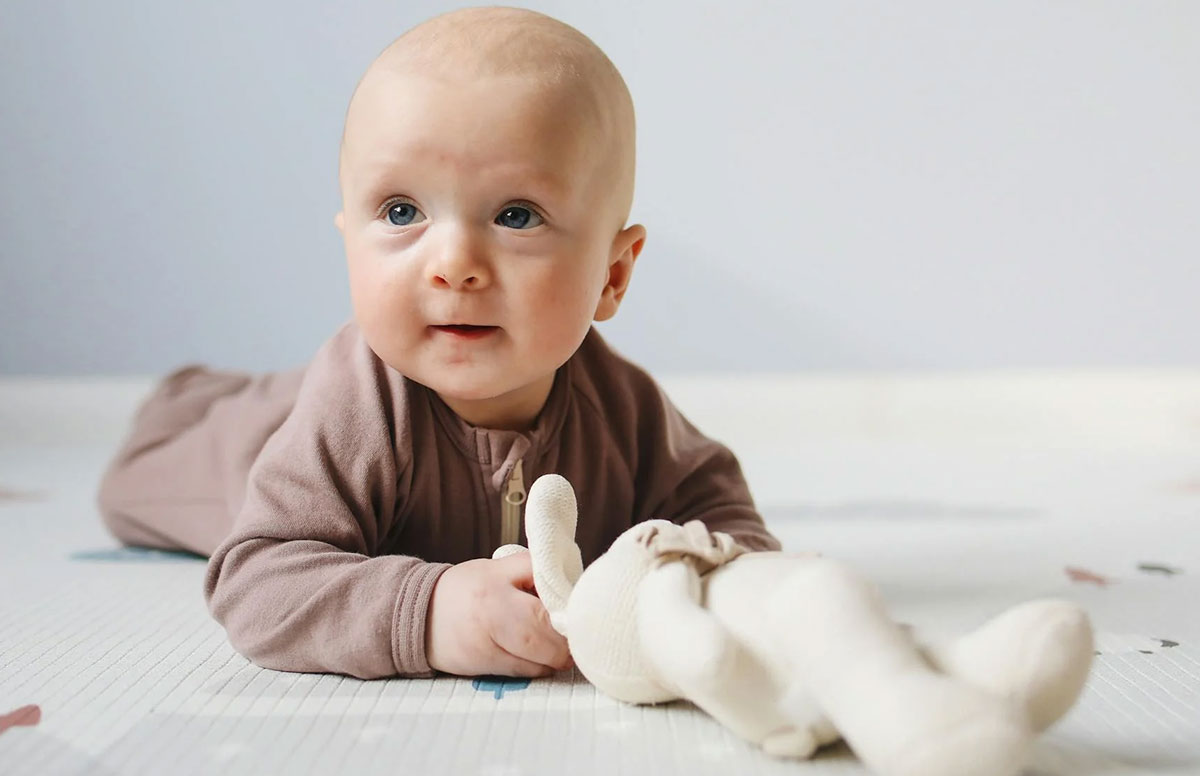
The response to these observations has been to recommend, and in some cases, mandate, tummy time for all babies. And evidence is that regular tummy time works—at least the babies that do it are less likely to have these observed motor delays in later infancy.
But what about babies that don’t like playing on their tummy? Is it really important?
Put another way: Does the delay in motor development among supine sleepers mean that they will also be delayed in later years, or will they catch up? And does supine sleeping actually cause delays from which children may never recover?
It has been observed, over the years, that babies delayed in motor development are more likely to have learning difficulties, lack of coordination, speech delay and other problems as they mature. It’s logical to believe that this is because subtle changes to the nervous system that cause such problems are first demonstrated with delays of motor development, not because later motor development actually causes the problems.
If you followed that, then you may guess my answer to the questions above. I don’t think that lack of tummy time is going to cause developmental abnormalities. An analogy would be: If most children receive basketball lessons at age four, and in this imaginary basketball loving place most children can make a free throw by age six, and children who take lessons but can’t make a free throw by six turn out to also be slow readers, if your child doesn’t take lessons at three, and consequently can’t make a free throw at six, are they also likely to be slow readers? I think not. Nothing about learning basketball necessarily correlates with reading. Children who were slow in basketball may just also be slow in other things.
Note: I can read, but I can’t make a free throw more than one in ten, so maybe the analogy is not the best.
Take home: Tummy time is a good idea, it can be fun, but if you can’t make it work, don’t obsess about it In the long run, your child’s development depends a lot more on how much you talk to them and how much you allow them to experience.
Work on those Abs!
Disclaimer: I’m not sure if my partners will agree with me on this one, but they let me write what I like. Just don’t assume they agree.
In the late nineteen eighties, reports began to appear in the medical literature that Sudden Infant Death Syndrome was less common in infants that slept on their backs. This information was, at the time, mostly disregarded in the United States, as the long custom in this country was to have babies sleep on their tummies and logic seemed to suggest that that would be the safest position. Although we have known for a long time that regurgitation was not the cause of SIDS, the lack of a real answer left most of us thinking that better safe than sorry, don’t risk choking, have babies sleep prone, on their tummies.
Within a few years, the evidence that SIDS was, in fact, a lot more common if babies slept prone became incontrovertible. There is now absolutely no doubt that supine sleeping (on the back) reduces the risk of SIDS by at least half. We’re not sure why this is true, but we definitely recommend that all infants sleep supine.
After we (meaning pediatricians the world over) changed to recommend the supine sleep position, at least three things were observed to happen: 1) SIDS dramatically declined in frequency, 2) We started seeing more children with flat and lopsided heads (about which more another time) and 3) An increased number of children weren’t passing their developmental milestones for gross and fine motor behavior at six to twelve months age.
The last observation was attributed, I think accurately, to the fact that children were spending less of their awake time on their tummies, manipulating objects with their hands and pushing up with their arms. For years, the standards for normal development, such as those on the Denver Developmental Screening Test, were pretty much unchanged. Babies tested in the 1950’s scored, on average, the same as babies tested in the 1980’s. But babies tested after the sleep position change tested, on average, as delayed in motor development.
The response to these observations has been to recommend, and in some cases, mandate, tummy time for all babies. And evidence is that regular tummy time works—at least the babies that do it are less likely to have these observed motor delays in later infancy.
But what about babies that don’t like playing on their tummy? Is it really important?
Put another way: Does the delay in motor development among supine sleepers mean that they will also be delayed in later years, or will they catch up? And does supine sleeping actually cause delays from which children may never recover?
It has been observed, over the years, that babies delayed in motor development are more likely to have learning difficulties, lack of coordination, speech delay and other problems as they mature. It’s logical to believe that this is because subtle changes to the nervous system that cause such problems are first demonstrated with delays of motor development, not because later motor development actually causes the problems.
If you followed that, then you may guess my answer to the questions above. I don’t think that lack of tummy time is going to cause developmental abnormalities. An analogy would be: If most children receive basketball lessons at age four, and in this imaginary basketball loving place most children can make a free throw by age six, and children who take lessons but can’t make a free throw by six turn out to also be slow readers, if your child doesn’t take lessons at three, and consequently can’t make a free throw at six, are they also likely to be slow readers? I think not. Nothing about learning basketball necessarily correlates with reading. Children who were slow in basketball may just also be slow in other things.
Note: I can read, but I can’t make a free throw more than one in ten, so maybe the analogy is not the best.
Take home: Tummy time is a good idea, it can be fun, but if you can’t make it work, don’t obsess about it In the long run, your child’s development depends a lot more on how much you talk to them and how much you allow them to experience.